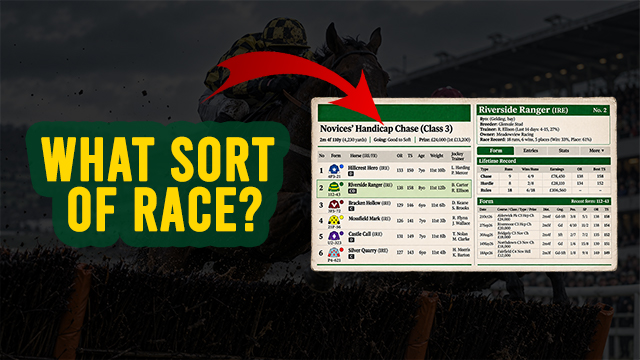
A Maiden Hurdle, a Novice Stakes and a Handicap Chase may sound like complete jargon if you are unfamiliar with British racecards. But once you know just two questions, you can work out what most horse races actually are.
If terms like maiden, novice, handicap, hurdle and chase leave you bemused, this article is for you. By the end, you will be able to look at a racecard title and quickly answer two things: what kind of race is this - and what sort of horses is the race for?
Flat racing versus Jump racing
Let us start with the basics: Flat racing versus Jump racing.
Flat
Flat racing is racing without obstacles. In Britain, most Flat racing takes place on turf from spring through to the autumn. However, all-weather tracks stage racing all year.
Races are staged over a variety of distances and abilities, from maiden races up to prestigious, valuable Group races such as the “Five Classics” which include the Derby.
Jumps
Jumps racing, also called National Hunt racing, has three terms you will see regularly: hurdles, chases, and National Hunt Flat races, usually called bumpers.
Again, like Flat racing, the Jumps are staged over a variety of distances, differing obstacles and a mix of abilities, right up to valuable Graded races and stamina-testing, gruelling long-distance handicaps - such as the Grand National.
But the one that can catch out those new to racing: a bumper has no obstacles to jump at all, but it is still run under National Hunt rules. Think of it like a nursery slope for potential future National Hunt horses.
So that's the first question solved: Flat or Jumps. Now comes the bit that makes racecards suddenly much easier to understand.
Maiden, Novice and Handicap
Maiden
A maiden is the first place to start. Broadly speaking, a maiden is a horse that has not yet won a race under the relevant type of racing.
But two words need highlighting: relevant type. A horse that has won on the flat can still be eligible to enter a jumps maiden race if it has not won over the jumps - and vice versa.
As an analogy, think of a maiden as a horse aiming to get its first tick in that particular type of racing.
Novice
Novice is where beginners can sometimes get caught out. A novice race does not necessarily mean every horse has never won.
On the flat, novice races can include maidens and horses that have won one or two races. Those previous winners may carry penalties (more weight), depending on the race conditions. In jump racing, a novice hurdler or chaser is generally defined as a horse that has not won in that discipline before the end of the previous season.
If a maiden is a horse that has not won a race yet, a novice is a horse that is still in the early stages of its racing career - it may have already won one or two races.
Handicap
Then we have handicaps, which you can read about in more detail in a previous article.
In a handicap, horses of different assessed abilities are given different weights to make the race more competitive. The higher-rated horse normally carries more weight; lower-rated horses normally carry less.
And this is the key: a handicap can be run on the Flat, over hurdles or over fences.
The overlap reveal
So here’s a point worth noting: these words aren't all competing labels. You can have a Novices' Hurdle, a Novice Handicap Chase, a Flat Maiden, or even a Maiden Handicap.
One part tells you the racing discipline. Another part tells you which horses can run or how the weights work.
Here’s a quick test: if the racecard says Novices' Handicap Hurdle, as it does in the example racecard below, can you spot the three clues?
The reveal is:
- Novices’ means eligibility.
- Handicap means different weights.
- Hurdle means it is a jumping discipline.
How to identify the race type on a racecard
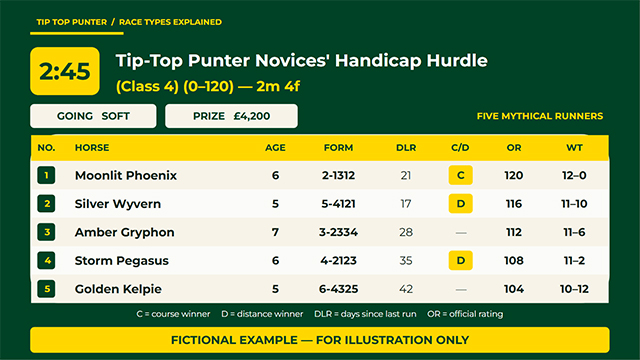
You don't need to understand every word at once. Read the title in layers.
Novices’
First: eligibility. These are horses that meet the conditions to qualify as novices for this race.
Handicap
Second: it's a handicap; that means the horses will carry different weights under the relevant handicap framework.
Hurdle
Third: we know exactly what discipline it is — hurdles, jump racing.
Class 4
This describes the race class. In this instance, it is a class 4.
0 - 120
This describes the relevant ratings band for this handicap.
2m 4f
And finally, the race distance. In this instance, it is 2m 4 furlongs - 2 and a half miles.
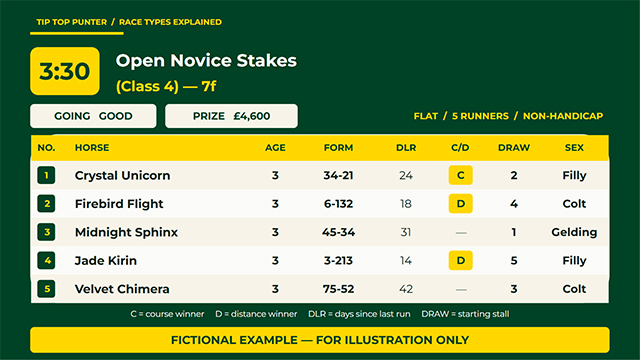
And in this Flat example above, you will notice there is no word ‘handicap’. That should stop you from assuming the weights work exactly as they did in our handicap video.
Some mistakes to avoid
Every horse race is a handicap.
This is false. Plenty of races are non-handicaps. Maiden and novice races can be run under conditions where weights aren’t determined the same way as a standard handicap.
A novice has never won.
Not necessarily. A novice race can contain previous winners, depending on the rules and conditions.
A maiden horse has never won any race anywhere.
Not necessarily. Maiden eligibility relates to the relevant code or discipline; a Flat winner can still qualify for a Jumps maiden if it hasn’t won over the Jumps.
A bumper is Flat racing.
It looks like a Flat race because there are no obstacles, but a bumper is a National Hunt Flat race run under Jump rules.
The race title tells me absolutely everything.
It tells you a lot, but the exact race conditions still matter. Age, sex, ratings, previous wins, number of runs and other restrictions can all affect eligibility.
You might also occasionally see selling races or claiming races. In a seller, the winner is offered for auction after the race; in a claimer, horses can be bought under the race's claiming arrangements. They're worth knowing, but we'll save the detail for another article.
Recap
So when you see an unfamiliar race title, don't panic. Ask yourself two questions.
First: is it Flat or Jumps?
Second: what are the conditions — Maiden, Novice, Handicap or something else?
Flat and Jumps describe the broad type of racing. Maiden, Novice and Handicap tell you more about eligibility or the conditions of the contest — and those labels can overlap.
Once you understand that, British racecards start looking far less mysterious.
How to find and back value winners