Imagine you are studying a betting market that you believe has a theoretical probability of 100%. So why do markets usually total 110% or even over 130%? Especially in horse racing?
That is the overround - the mathematical edge built into the betting market. It is like the zero on a roulette wheel in a casino. But on a more fluid, fluctuating scale. Understanding this could change the way you look at betting odds.
In this article, I will show you:
- How to read British fractional odds
- How to calculate implied probability
- How to measure the bookmaker’s edge
And, most importantly, how you can decide whether a particular horse might actually offer value before placing a bet.
Understanding fractional odds
British bookmakers traditionally quote horse racing (or any other sport) prices as fractions. You will often see prices such as: 6/4, 2/1, 5/2, 4/6, etc.
The first number in the fraction tells you the potential profit, the amount of money you would win if your selection wins. The second number tells you the stake required to win that profit.
Of course, when you place a bet, your stake can be any amount you wish, within the bookmaker’s minimum and maximum limits.
For example:
At 5/2, you will win £5 profit for every £2 staked. You will also get your original £2 stake back, giving a total return of £7.
At 6/4, you will win £6 profit for every £4 staked. So, a £1 stake thus wins £1.50 profit. Plus your original £1 stake back, giving a total return of £2.50.
Calculate implied probability
To turn a fractional price into implied probability, use this formula:
- Add both numbers together.
- Divide the bottom number by the sum above.
As an example, 5/2 would be 2 divided by 7, giving an implied probability of about 28.6%.
6/4 would be 4 divided by 10, giving an implied probability of 40%.
Evens would be 1 divided by 2, an implied probability of 50%.
Calculating the overround
To work out the bookmaker’s overround, use the following three steps:
First, convert every horse’s price into a probability.
Second, add those probabilities together.
Third, subtract 100%.
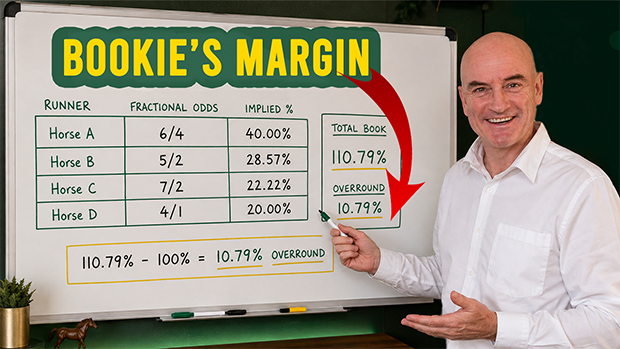
Let us take a small four-runner field to explain how this works.
We will convert each horse’s fractional odds into an implied probability. Add them together, and we get a total book probability of 110.79%.
Deduct 100% from the total to leave 10.79% - that is the overround. You will often hear that as a 10.79% bookmaker margin.
Do not assume the bookmaker has spread the whole overround evenly. The bookmaker can apply different effective margins to different runners.
There is no guarantee the bookmaker will profit on every race. The actual result depends on the amount of money taken on each horse.
Finding value
Many believe that a lower overround is better for the punter. That could be true as it generally means a more competitive market. But it does not automatically tell you which horse to back.
For example, you can take a bad individual price in a surprisingly low overround market. Likewise, you could find an overpriced horse in a high overround market.
Remember, the overround measures the market; value measures the bet.
To find value bets, you will need an understanding of form to ascertain your implied winning probability and fair odds. To find fair odds, you reverse the implied probability calculation described earlier.
Value exists when the offered odds exceed your perceived fair odds.
Converting implied chance into fair odds
To convert implied chance into fair odds, divide 1 by your chance, then subtract 1.
Let’s suppose a horse is available at 4/1, which is a decimal of 5.00. The bookmaker’s price implies a 20% chance.
After you have studied the horse’s previous form, race conditions, weight, and class, you estimate the horse's chance at 25%.
So, 1 divided by 0.25 will give you a decimal of 4.00. Subtract £1 stake, and you have fair fractional odds of 3/1.
You believe the fair price is 3/1. The bookmaker is offering 4/1. That is a potential value bet!
Long-term profit
But your probability could be wrong. A value calculation is not a guarantee that the horse will win. Or even that similar bets will show a profit quickly.
But it does mean that if your estimates are sufficiently accurate and you repeatedly obtain odds above fair value, the mathematical expectation is positive.
Value is key to long-term profitability.
Summarise
Common mistakes to avoid are:
- Treating implied probability as true probability
- Calling a market value simply because it has low overall overround
- Ignoring better prices elsewhere
And consider that withdrawals, deductions, each-way terms and promotional conditions can affect the final return.
Before placing your next horse racing bet, ask yourself four questions:
- What probability does this price imply?
- What is the overround of the full market?
- What do I believe the horse’s genuine probability is?
- Is the offered price high enough to compensate for the uncertainty?
Remember, margin describes the market; value describes the price.
Consistently finding value selections is the hard part. But there is a logical, systematic approach to finding value. That is to rate every runner in a race. If you want to know how, click here to start rating races today!
Struggling to find value winners? Click here and start compiling your own ratings!.