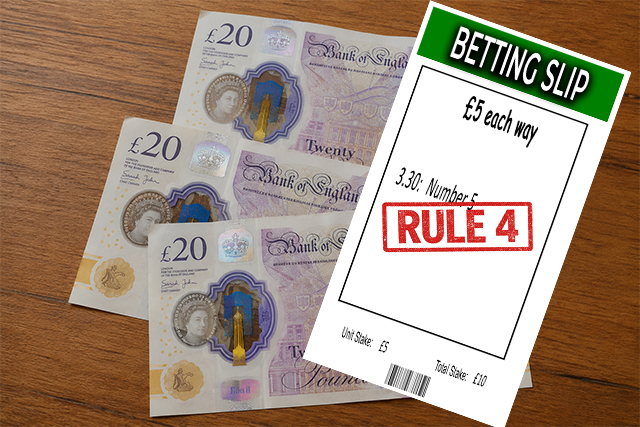
You’ve backed a winner, then found your payout came back a tad shorter than expected? And a bitter feeling left you thinking, “The bookie just screwed me, right?”
Years and years working for the bookies, and barely a week went by without me having to explain this scenario.
It’s because of that small print “Rule 4”, when a horse becomes a non-runner, that will often shave a bit off of your returns.
Stick with me for a few minutes, and I’ll explain exactly why this happens. So, by the end of this article, you will know:
- What Rule 4 is
- Why is Rule 4 applied?
- How much will be deducted?
What is the Rule 4?
Rule 4 is a Tattersalls Committee rule that can apply a deduction if a horse is withdrawn and becomes a non-runner.
Now, in case you are wondering, the Tattersalls Committee is an independent body that sets rules for on-course horse racing betting and adjudicates betting disputes. Today, adjudication services are generally conducted by IBAS - the Independent Adjudication Service.
The important point is that the Rule 4 deduction comes off your winnings, not your stake.
Why is Rule 4 applied?
- Bookmakers price a race with the assumption that all declared runners will take part.
- When a horse is withdrawn, it will have an impact on the betting market, and a new betting market will be formed.
- Rule 4 compensates for the changes to the betting market to bets struck before the horse being withdrawn and the new betting market being formed.
Now, the time of the withdrawn horse matters when it comes to applying Rule 4. So, let’s look at that now.
“Early” Rule 4
Only bets placed before the withdrawal, and the new market being formed, will be subject to the Rule 4 deduction. Meaning, if you struck your bet early, before the horse was withdrawn, and you took the early price on offer, you’ll receive a Rule 4 deduction.
Imagine you’ve backed a horse that is the second favourite, at say 2/1. Then, before the off, the favourite, which was odds-on at 4/9, is withdrawn and becomes a non-runner.
That would realistically make your selection become the new favourite.
And so, a new betting market would be formed, and a Rule 4 would be applied to all bets that were placed prior to that adjusted market being formed.
“All bets” Rule 4
This usually happens right before the off. A horse is withdrawn before coming under the starter’s orders. There is no time to form a new market, and so, a “all bets” Rule 4 is applied.
Picture the scenario: It’s a flat race, the handlers are loading the stalls, and a horse becomes unruly and refuses to enter the stalls.
It is not deemed under starters' orders and is declared a “non-runner.” That will be an “all bets” deduction.
How the deduction is worked out
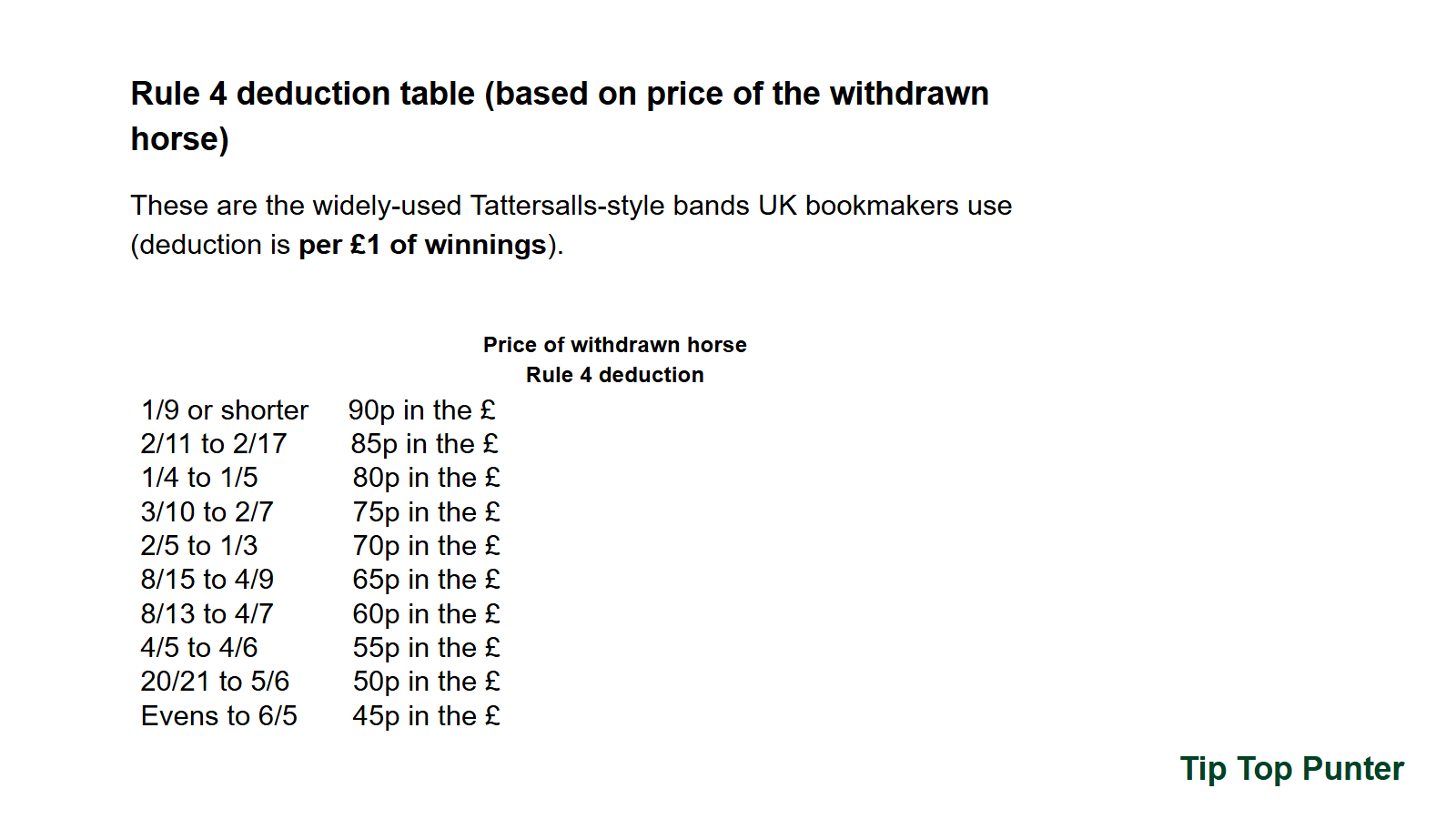
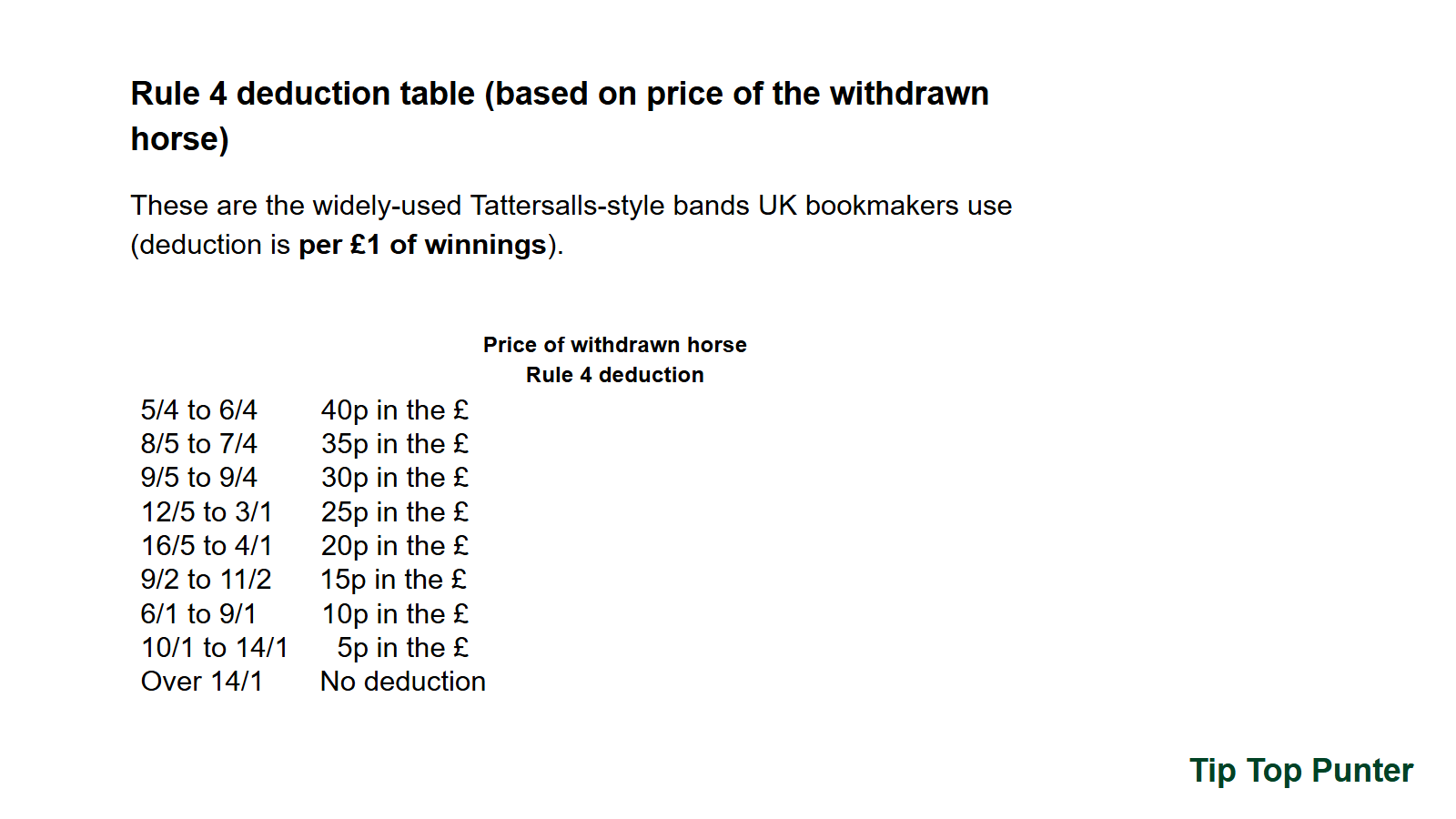
The size of the Rule 4 depends on the price of the horse at the time it was withdrawn.
- Short-priced favourite withdrawn? Bigger deduction.
- A big outsider withdrawn? Tiny deduction, if any at all.
Here’s an example:
You bet £10 on a horse at 5/1.
- Normal winnings would be: £10 × 5 = £50 profit (plus your £10 stake back).
- Then a horse is withdrawn, and Rule 4 of 20p in the £ is applied (that’s 20%).
- Deduction is 20% of your winnings: 20% of £50 = £10.
- So winnings become £40, plus your £10 stake back = £50 returned.
Final thoughts
If you’ve ever been frustrated or confused by the shaving of your winnings, hopefully it makes sense now. The Bookmaker hasn’t stitched you; it’s just a balancing of the market when a horse becomes a non-runner.
So, with all that in mind, hopefully, you won’t slate me should the Rule 4 happen to you, and should we meet at the races!
Struggling to find value winners? Click here and start compiling your own ratings!.