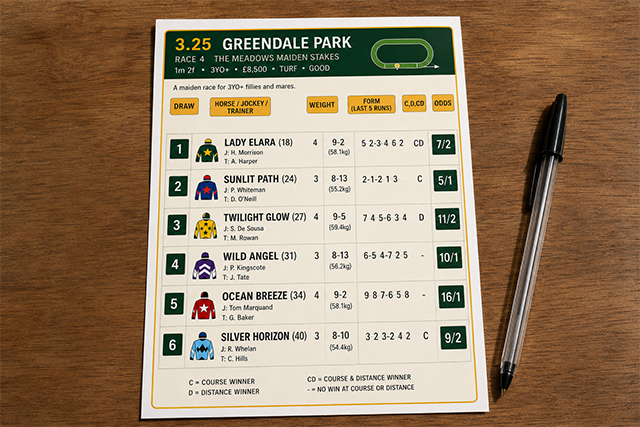
Have you ever spent a Champagne-flowing day at the races, opened your racecard, and thought - what on earth does all this mean? A line of numbers, letters and strange characters.
It’s confusing, right? But when you know what you are looking at, the racecard is a useful tool for a punter. By the end of this article, you will know how to read a horse racing racecard, what the key information means, and how to use it before placing your first bet.
So, lesson-up, I am going to turn the confusion into clarity.
What is a racecard?
A racecard provides you with a wealth of information. It tells you which horses are running, who is riding them, what weight they will carry, their recent form, the race distance, the going and plenty more.
No more blindly backing bad favourites or a name you like, when you understand the information.
We are going to dive deep into the basics.
The race details
You’ll likely see the time of the race, the racecourse, the distance, the class or grade of the race, and the prize money.
For example, it might say: 2:30 at Ascot, 6 furlongs, Class 4 Handicap.
That tells us the following:
- The Time of the race.
- Where the race is being run.
- Distance: How far the horses will race.
- Class: The general quality level of the race.
- Race type: This could be a handicap, a maiden, a novice, a conditions race, or a group race, etc.
- Prize money: Often a clue to the quality of the race.
Start by understanding the basics: where, when, how far, and what sort of race it is. You don’t have to master every type of race straight away.
The Going
The going is a description of the ground. In Britain, our lovely and often changeable weather can make a big difference.
During the summer months, you may see good, good-to-firm or even firm on your racecard - when the sun is blazing, and the horses are sprinting.
Once the rain comes, you may see good-to-soft, soft, soft-to-heavy or even heavy. The more rain, the softer the ground. That is often the case with jump racing.
But here’s the thing: Some horses enjoy quick ground. Others prefer it softer. A horse that runs well on good ground may not enjoy heavy ground at all.
Runner number and draw
Each horse on the racecard will have a number next to its name. That is its runner number.
In flat racing, you may also see the draw (shown in brackets next to the runner number). This is the stall from which the horse will start the race. So, draw 1 means the horse is starting from stall one.
The draw can be important on some courses and over some distances. A low draw might be helpful in one race, while a high draw may be better in another.
Horse details
Next to the horse’s name, you will see its age and sex. For example, a horse might be listed as a 4-year-old gelding or a 3-year-old filly.
Quick definitions:
- Colt is a male horse, usually up to four years old.
- A filly is a female horse, usually up to four years old.
- Gelding is a castrated male horse.
- Mare is a female horse, usually five or older.
- A horse is a male horse aged five or older.
So, age can matter. A young horse may still be improving, while an older horse may be more experienced.
Headgear and equipment
Also, next to the horse’s name on the racecard, you might see letters showing headgear or equipment. This indicates whether a horse is wearing blinkers, a visor, cheekpieces, or a tongue-tie.
- Blinkers: Help the horse concentrate by limiting side vision.
- Cheekpieces: Encourage focus without being as strong as blinkers.
- Visor: Similar to blinkers but with a small slit.
- Tongue-tie: Helps with breathing or tongue position.
First-time headgear can sometimes improve a horse, but it can also be a sign that connections are trying something new because things have not quite been working.
Form figures
Now we get to the “flesh” of the racecard. The clues to the horse’s current form. That line of numbers and characters tells you where the horse finished in its previous races. That’s a wealth of information.
The figures show the horse’s finishing position. Zero means it finished outside the top nine or ten, depending on the racecard.
Other abbreviations include:
- F - fell
- BD - brought down
- U - unseated tider
- P - pulled up
- R - refused to race
- D - disqualified
- - means a season break
- / means a two-season break
So if a horse’s form reads 212, it has recently finished second, first, and second. That suggests it has been running well.
But a word of caution. Form figures are only the starting point. You also need to ask: what level was the horse running at, what distance, and against what sort of competition?
Weight carried
In British horse racing, weight carried is usually shown in stones and pounds. For example, a horse could be carrying 9 stone 7 pounds.
In handicap races, the higher-rated horses (as per their official rating) are asked to carry more weight to give the others a fairer chance. The handicapper is trying to slow it down a little.
Don’t get too bogged down in weight straight away. But do notice whether a horse is carrying a lot more or less than last time.
Jockey and trainer
Every racecard will show the jockey and trainer. The trainer prepares the horse, and the jockey rides it in the race.
Some trainers are particularly good at certain courses. Some jockeys ride certain tracks brilliantly. Some jockey-and-trainer partnerships are recognised for being very strong.
If you’re new to betting on racing, this is a useful thing to look at. A horse ridden by an in-form jockey for an in-form yard is something worth noting.
Course and distance clues
Many racecards use simple letters as clues:
- C means the horse has won at the course.
- D means the horse has won over the distance.
- CD means the horse has won at the course and distance.
If a horse has won (or come a close runner-up) at today’s track and/or distance, you can be confident it can do so again. It’s a big thumbs up!
Summary
The racecard may seem complicated when you first try to study it. But with practise, recognising and understanding the information becomes second nature in time.
Success depends on how you use that information.
Gain the power to spot value bets that the majority of punters miss by utilising the valuable information you have now gained to form a realistic rating for each runner. Click here to discover how.
Struggling to find value winners? Click here and start compiling your own ratings!.