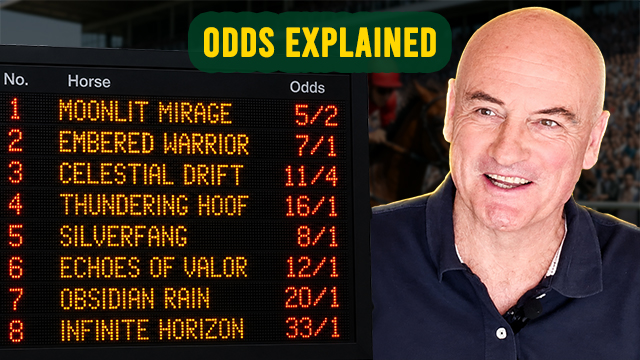
If I show you 7/4 and 33/1, could you instantly tell me which horse is more fancied, what a tenner returns, and what chance the bookmaker is implying? If not, this is the only odds lesson you need before placing your first British horse-racing bet.
In horse racing, odds are doing two jobs. First, they show what you’ll win if your horse wins. Second, they signal how likely the bookmaker reckons that outcome to be. In Britain, you’ll usually see that in fractional odds like 2/1, 5/2 or 7/4.
Profit and return
In fractional odds, the left number represents profit, and the right number represents the stake you will need to win that profit. So, for example:
- 7/4 = £7 profit for every £4 staked.
- 2/1 = £2 profit for every £1 staked.
- 5/2 = £5 profit for every £2 staked.
Your total return would be profit plus your stake. For example: £5 at 5/2 would give you £12.50 profit. Plus your £5 stake, giving you a total return of £17.50.
Let’s make the maths easier by converting the fractional odds into decimals.
Fractions into decimals
We can make the maths easier by converting the fractions into decimal prices. There are two ways of doing this.
The first way is to divide the top number by the bottom number, then add one. So, for 7/4, 7 divided by 4 plus 1 gives you 2.75.
Or,
The second way is to add both numbers together, then divide by the bottom number. So, for 7/4, 7 plus 4 divided by 4 gives you 2.75.
What’s good about decimal odds is that you only have to multiply your stake by the decimal price to get your total return.
Implied probability
So how do we work out the implied probability of each horse based on the bookmaker’s price?
We use 100% probability divided by each selection’s price. For example:
- A horse priced at 7/4 (100 divided by 2.75) gives an implied probability of about 36.4%.
- A horse priced at 2/1 (100 divided by 3.00) gives an implied probability of about 33.3%.
- A horse priced at 5/2 (100 divided by 3.5) gives an implied probability of about 28.6%.
Basic prices and returns
Let’s look at some basic bookmaker prices that punters actually see.
- £10 @ 2/1 = £30 return
- £10 @ 5/2 = £35 return
- £10 @ 7/4 = £27.50 return
- £10 @ 10/1 = £110 return
- £10 @ 33/1 = £340 return
Can you see an emerging pattern here? Longer odds offer a bigger payout, but they also imply a lower chance of winning.
Odds-on and odds-against
Whether you are at the races or in your local betting shop, odds-on and odds-against are terms you will hear.
Odds-on means the price is shorter than evens, so the implied chance is over 50%. Think 1/2 or 4/5. You’re more likely to be right, but your profit will be smaller than your stake.
Odds-against means the price is higher than evens, so the implied chance is under 50%. Think 2/1, 5/2 or 10/1. Less likely chance, but the reward is bigger, so your profit will be more than your stake.
How do bookmakers come up with these prices?
They estimate probability using factors like statistics, past performance, and market opinion. But here’s the bit those new to racing often miss: they also build in a margin.
The overround
You now know how to work out the implied probability by converting fractional odds into decimals and then using 100 divided by the decimal.
But a bookmaker’s market on any race will usually add up to more than 100% probability when you compare every horse’s odds in a race. That is the overround, which is the bookmaker's edge.
I will delve deeper into the bookmaker’s overround in a future blog post. If you don’t want to miss that, bookmark this website by clicking the star symbol to the right of your browser’s address bar, and then come back to learn more.
Fixed odds or SP?
In British horse racing, you also need to know the difference between fixed odds and SP, otherwise known as starting price.
Fixed odds means you take the price that’s on offer when you place the bet. SP means you accept the official price at the start of the race.
When you place a bet with an on-course bookmaker in the betting ring, you will usually be given the price of the horse at the time you placed the bet, and this will be shown on your betting slip.
However, this generally is not the case if you place your bet in a high-street or on-course betting shop. If you don’t request the price, your bet will be settled at SP.
Why does this matter?
Odds can move before the off. Sometimes the SP will be higher than the early price; sometimes shorter.
Summary
So, to conclude, don’t:
- Confuse profit with total return.
- Forget to convert odds into probability.
- Treat a short-priced favourite like a guaranteed winner.
- Stake emotionally after a loss. Don’t chase losses but bet responsibly.
And remember to check whether you are taking fixed odds or SP (starting price).
Now you know how to read fraction odds, convert them, and control the stake, you’re already ahead when it comes to profitable betting.
Struggling to find value winners? Click here and start compiling your own ratings!.