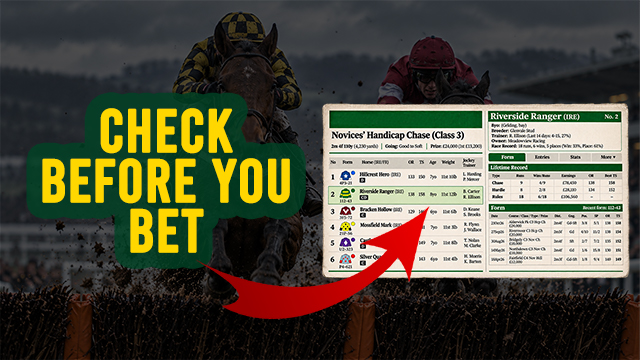
Why would you consider backing a horse carrying 15 pounds more than its rival? Well, the answer could be hiding in just five things on this racecard.
If you have ever looked at a racecard and wondered what all those numbers, letters and weights actually mean, this article is for you.
I will show you five simple checks you can make before considering a bet. And, with jumps season, we'll use a proper jumps-racing example, with hurdles, soft ground, and handicap weights.
By the end, you will know what to look for — and, just as importantly, what not to assume before placing a bet.
The important thing to remember:
We are not trying to prove whether a certain horse will win. We are asking whether today's race looks suitable before considering a bet.
A fictional National Hunt race
Here is our example. It is a handicap hurdle over two miles and four furlongs, on soft ground.
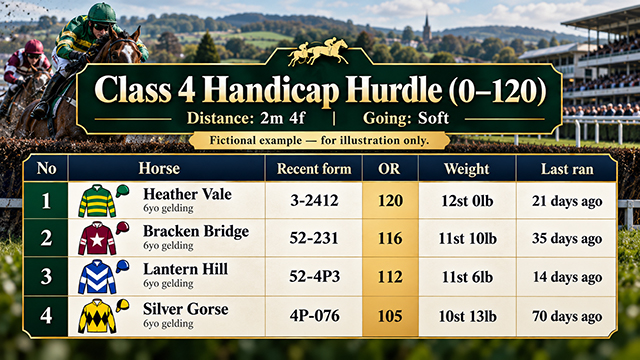
That means the horses will be jumping hurdles, the race is roughly two and a half miles long, and the ground is expected to be fairly testing. It is also a handicap, meaning the horses carry different weights based on their official ratings. We covered that in a previous article.
1: Check the form figures
First, let's look at the form figures to see how a horse finished in its previous races. Read them from left to right, with the most recent result on the far right.
Look at Heather Vale: 3-2-4-1-2. That final 2 tells us it finished second last time out.
Now look at Bracken Bridge. Its final figure is 1 — meaning it won its most recent race.
But jumps racing also has letters. For example, P means a horse was pulled up, F means it fell, and U means it unseated its rider.
Lantern Hill has a P in its form. That doesn't automatically mean it's a bad horse. We need to look a little deeper before placing a wager.
A quick question: would you automatically back the horse with the 1 next to its name? Not so fast.
2: How recently has the horse run?
Next, look at when each horse last raced.
Heather Vale ran 21 days ago. Bracken Bridge ran 35 days ago. Silver Gorse hasn't raced in 70 days.
A long break is not necessarily a bad thing. Some horses run particularly well when they're fresh. But if a horse hasn't raced for a while, it's worth checking whether it has a history of performing well after a break.
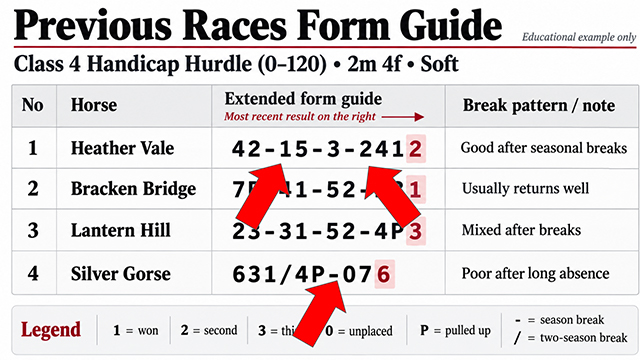
Equally, a horse that's raced recently might be race-fit — or it might still be recovering from a hard race. So don't just look at the number of days. Look at the horse's record around those breaks.
Now, even good recent form can be misleading if it came in the wrong type of race. So let’s move on to our third form check to consider before backing a horse.
3: Course, distance and race type
Our third check is whether today's race suits the horse.
Today's race is over two miles and four furlongs, and it's a hurdle race.
Heather Vale finished second over this distance last time out, so we already have evidence it can handle the trip.
Bracken Bridge also won over two miles and four furlongs on its latest start, again, evidence it can handle the trip. But Lantern Hill's recent third place came over just two miles. That's half a mile shorter than today's race. It might stay the longer distance perfectly well — but that's something we need to investigate, not assume before backing it.
You might also see the letters C, D or CD beside a horse's name.
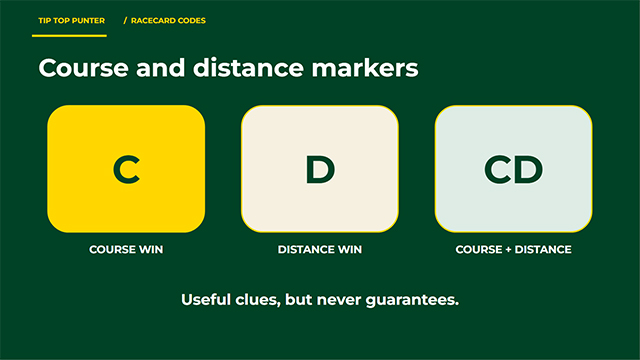
C means it's won at the course before. D means it's won over the distance. And CD means it's won over both this course and distance.
Those are useful clues, but they are not guarantees.
And in National Hunt racing, remember that hurdles and steeplechases are different disciplines. A horse that's been running over fences might not show the same form when switching back to hurdles. And vice versa!
4: The going
Next, check the going. That means the condition of the ground. Today's going is soft, which can make a race more demanding.
Heather Vale's latest second place was on soft ground, so that's encouraging. Bracken Bridge's last win was also on soft ground.
But Lantern Hill's latest third was on good ground, which is different. We need to look further back to see how it has performed on softer conditions.
You can access all the information around a horse’s past races online through the Racing Post.
Another quick question: would you rather see a horse with a recent win on good ground, or a solid second on today's soft ground? The answer depends on the rest of the form.
5: Class, official ratings and weights
Now for our fifth check — and this is where that 15-pound difference from the beginning comes in.
This is a Class 4 handicap hurdle for horses rated up to 120. OR stands for Official Rating. In simple terms, the higher the rating, the better the horse is judged.
Heather Vale has a rating of 120 and carries 12 stone.
Bracken Bridge is rated 116, which is four points lower, so in our example it carries four pounds less — 11 stone 10.
Lantern Hill is rated 112 and carries 11 stone 6.
And Silver Gorse, rated 105, carries just 10 stone 13.
So Heather Vale carries 15 pounds more than Silver Gorse. But here is the important bit: that doesn't automatically make Silver Gorse the better choice when considering a wager. Heather Vale carries more weight because the handicapper assesses it as the stronger horse. The handicap is designed to make the contest more competitive.
And here is an important note: in real races, penalties, allowances, minimum weights and race conditions can affect the final weight. This simplified example is not an absolute rule for every handicap.
Class
And another thing to check: the class of the horse's previous races compared to today.
Heather Vale was second in a Class 4 race last time. Bracken Bridge won a Class 5 race. That's a good result, but it is now moving up into a stronger class.
So a second place in a stronger race might be just as interesting as a win in a weaker one.
One final detail: horses can have different handicap ratings over hurdles and fences, so make sure you're looking at the rating relevant to today's race. Again, you can find all this information online in the Racing Post.
Putting it all together
Right, let us see what we have learnt from our four runners.
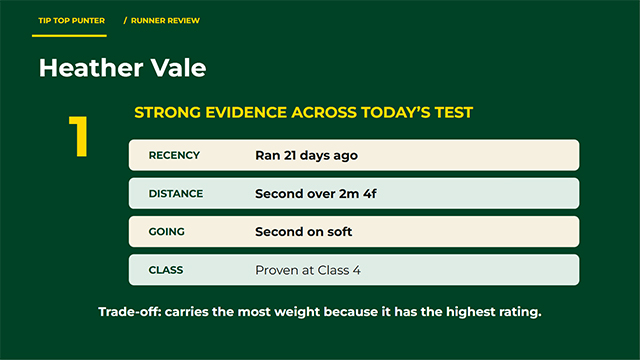
Heather Vale has recent form, has run well over today's distance and on soft ground, and has performed in this class before. It ticks a lot of boxes. But it carries the most weight, and that is for good reason.
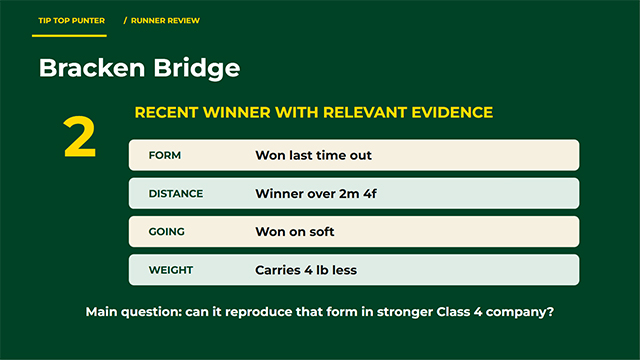
Bracken Bridge won last time out, has winning form over today's distance and on soft ground, and carries four pounds less. But it is stepping up in class, so it faces potentially stronger competition today.
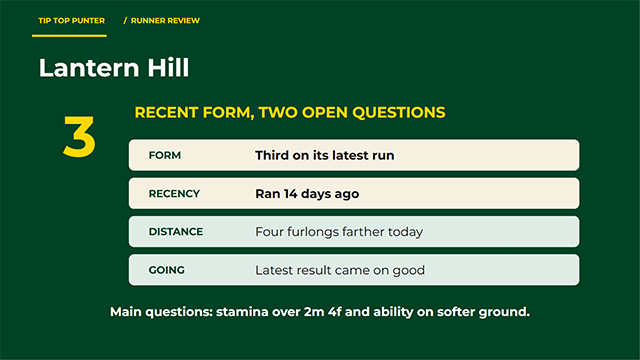
Lantern Hill ran recently and finished third, but we're less certain about the longer distance and softer ground it faces today.
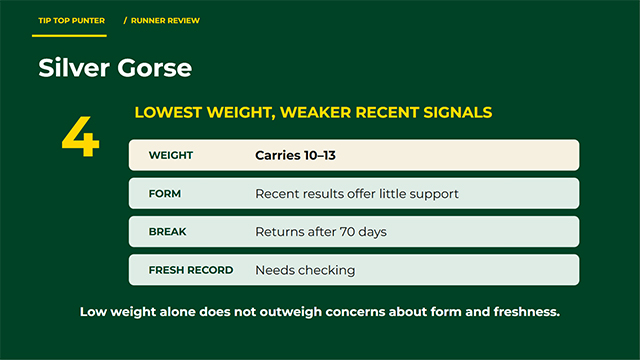
And Silver Gorse carries the least weight, but its recent form isn't especially encouraging, and it is returning after a longer break.
So rather than blindly choosing the last-time-out winner or the least weight-carrying horse, we have identified the questions we actually need to answer.
Both have positives. Both have things to consider. And we still haven't looked at their odds. That's important because finding a horse with a good chance and finding a bet that offers good value aren't necessarily the same.
You won't find every winner this way — nobody can guarantee that. But you will have a much better understanding of what you are looking at.

You can simplify everything we have covered today by compiling your own ratings to find value selections. Finding an edge is the only way to profit over the long term.