
Why does the best horse in a handicap often carry the most weight? Because handicaps exist to level the playing field. Let me show you how ratings become pounds.
If numbers and characters like 72, 9-4, and 'OR' on a racecard leave you wondering what they all mean, this video is for you. By the end, you'll know what an Official Rating is, how it affects a horse's weight, and—most importantly—why that matters when you're assessing a handicap race.
What is a handicap?
First, let's look at what exactly a handicap race is.
Handicaps are races designed to let horses of different abilities compete more evenly. Better horses generally carry more weight, and lower-rated horses will carry less.
According to the BHA, around six in ten British races are handicaps, so this isn't some obscure corner of racing — it's something you will come across again and again.
The handicapper will allocate weight based on the horse's official rating.
What is an official rating?
The official rating is the OR number shown on the racecard. It is a numerical assessment of the horse's ability. The higher the number, the higher the horse's assessed ability.
Remember: an OR of 80 doesn't mean an 80% chance of winning. It isn't a probability. It's a handicap mark.
If you use the Racing Post racecards, don't confuse OR with RPR. OR is the BHA's Official Rating. RPR is Racing Post's own rating.
A basic example
Now here is the important bit. In the basic handicap calculation, every one-point difference in rating represents one pound in weight.
Let's invent a four-runner Flat handicap. We'll call the horses Oak, Birch, Ash and Elm. Assume there are no jockey claims, age allowances or penalties — we're keeping this deliberately simple.
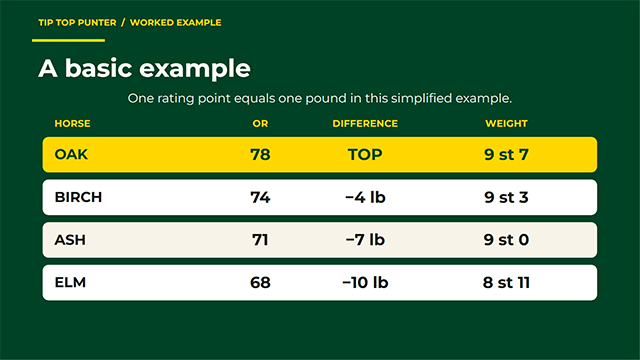
Oak is rated 78 and has a top weight of 9 stone 7. Birch is rated 74 — four rating points lower — so carries four pounds less: 9 stone 3. Ash is rated 71, seven pounds lower, so carries 9 stone exactly. Elm is rated 68 — ten points lower — so carries 8 stone 11.
You don't need complicated maths. Find the difference between the ratings; that tells you the basic difference in pounds.
What do the racecard weights mean?
When you see 9-7 against a horse on the racecard, it means the horse will carry nine stone seven pounds' weight. There are fourteen pounds in a stone, so dropping fourteen pounds from 9-7 takes you to 8-7.
The weight includes the jockey, the riding equipment, and, if necessary, extra added weight. Jockeys weigh out before the race and weigh in after. This ensures the horse has carried the correct allocated weight during the race.
For a punter studying a handicap race, the key thing to note is the difference in weight the horses are carrying.
Finding an edge
Why does finding an edge matter? Because it is the only way to profit from racing in the long term. That basically means seeking value bets.
Let's compare two horses. Horse A is rated 74, and Horse B is rated 70. In a usual handicap, Horse A would give Horse B four pounds. Why? Because the handicapper believes Horse A has roughly four pounds more ability to compensate for.
But an astute punter who has studied the form believes there is good evidence that Horse B now is capable of running more like a 74-rated horse in today's conditions. It is still receiving those four pounds from Horse A. That is the sort of situation punters mean when they say a horse might be ahead of the handicapper.
But notice the word might. A horse that may be well-treated at the weights does not guarantee anything.
Ratings change
The BHA reviews performances and publishes current ratings every week. If a horse runs better than its current mark, its rating may rise. Likewise, if a horse continues to perform below its current mark, it will eventually come down.
So, going back to our 70-rated horse example, let's imagine it won the race impressively. Its rating is therefore reassessed and raised to 76. Next time, all else being equal, it has six pounds less help from the handicapper.
Additional factors
Do not assume the rating is the only thing that matters. A horse may underperform because of the going, distance, pace, draw or other circumstances. The BHA does consider those factors before deciding whether a poor run really deserves a lower mark.
You will also sometimes hear terms like "out of the handicap", weight-for-age allowances, and jockey claims. These are additional factors beyond the horse's official handicap rating and are separate subjects for another article.
Final checklist
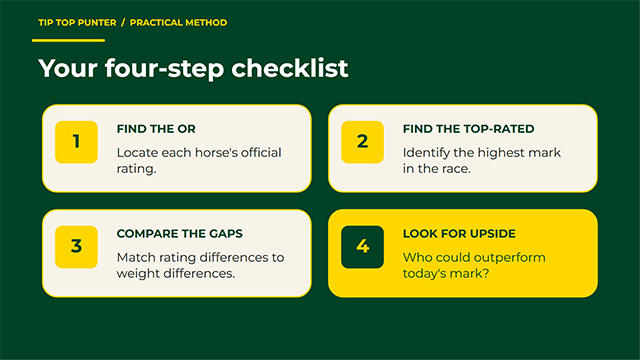
So, the next time you open a handicap racecard, use this quick checklist:
- Find the ORs.
- Identify the top-rated horse.
- Compare the different ratings with the weight differences.
- Ask whether any horse looks capable of performing better than its current mark suggests.
And finally, put that into context — going, distance, recent form, course, class and everything else that matters today. That is how the numbers on a racecard start turning into a picture of the race.
And remember: handicapping can help you understand a race; it can't remove uncertainty. Always bet responsibly.
Recommended:
How to read a racecard then bet with confidenceStruggling to find value winners? Click here and learn how to compile your own ratings!.