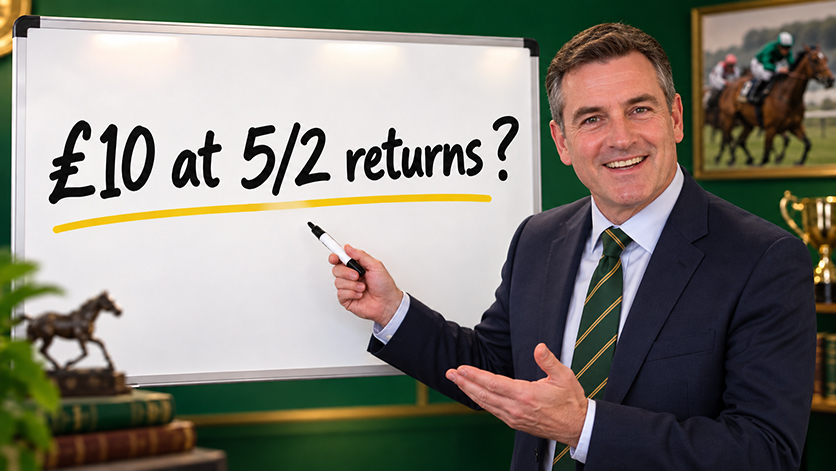
You’ve put a tenner on a horse at 5/2, and it wins. What do you get back: £25, £35, or something else? And what if it dead-heats?
I’m going to make settling bets ridiculously easy.
Settling a bet means working out what your bet is worth once the result is known.
For British racing, it boils down to the type of bet you placed, how much you staked, the price you took, and the official race result. The BHA establishes the racing result. Your bookmaker then applies its published settlement rules.
How fractional odds work
So, let’s begin with that 5/2 winner.
In fractional odds, the top number represents the profit you could win, and the bottom number represents the stake needed to win that profit. So, at 5/2, you would win £5 profit for every £2 staked.
To convert a fraction to a decimal, first divide the top number by the bottom number, then add 1 to include the stake.
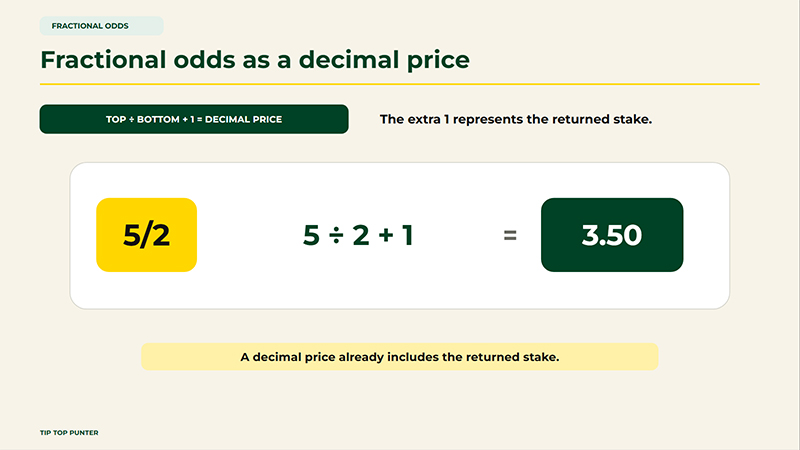
So, 5/2 would be 5 ÷ 2 = 2.5. Add a £1 stake = 3.5.
So, £10 at 5/2 would be 3.5 × £10 = £35 returned.
£25 profit plus your £10 stake money.
The quick way to settle
I learned, as a bet settler for the bookies, that there is a quicker way to settle. You will need a calculator.
To work out your total return, add the two numbers in the fraction together, divide by the bottom number, then multiply by the unit stake.
So, £10 at 5/2 is 5 + 2 ÷ 2 × £10, which gives you £35 returned. That is £25 profit plus your £10 stake money.
£5 at 12/1 would be 12 + 1 ÷ 1 × £5 which gives you £65 returned. £60 profit plus your £5 stake back.
£25 at 15/8 would be 15 + 8 ÷ 8 × £25 which gives you £71.88 returned. £46.88 profit plus your £25 stake back.
Question 1
A question to test your understanding so far.
What would be the returns on £15 at 5/2?
You will find the answer at the end of this article.
How to settle accumulators
The same principle for settling singles applies to working out doubles, trebles, etc.
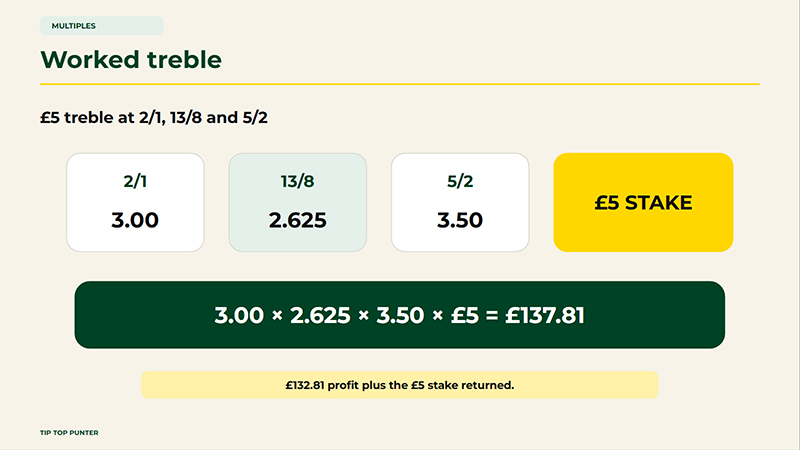
Let’s say you want to settle a winning treble consisting of 2/1, 13/8, and 5/2 to a unit stake of £5. Convert the fractions to decimals, multiply them together, then multiply by the stake.
However, we can use the quick settling method we discussed earlier.
A reminder: add together the top and bottom numbers in each fraction, divide by the bottom number, then multiply the results by the stake.
So, 2/1 × 13/8 × 5/2 × £5 would be:
3 ÷ 1 × 21 ÷ 8 × 7 ÷ 2 × £5 = £137.81 returned.
£132.81 profit plus your £5 stake.
Question 2
If it all makes sense, try answering this question.
What would be the return on a £10 winning double @ 6/4 and 2/1? Use the same total return formula.
Again, the answers are at the end of this article.
How to settle a dead heat
If two (or more) horses cross the line together and the judge cannot declare an outright winner after the photo finish, the result is known as a dead heat. To settle the bet, divide the unit stake by the number of horses involved in the dead heat.
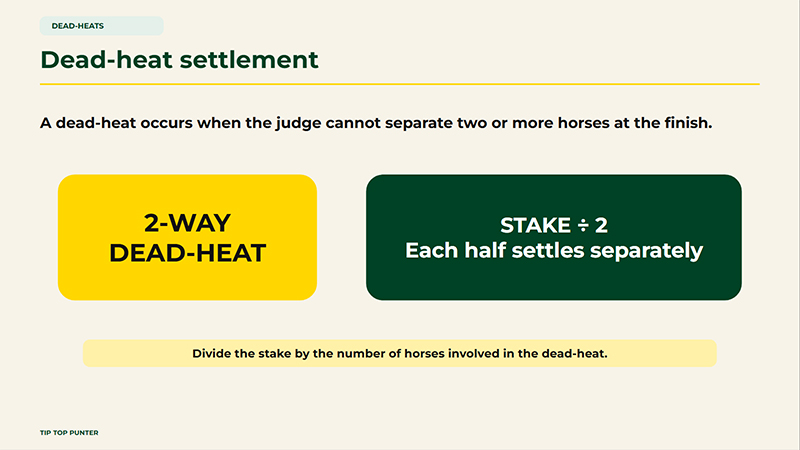
Let’s say you placed £10 on a horse to win at 4/1; the horse dead-heated for first place with another horse—a 2-way dead heat. Your stake will therefore be divided by two.
£10 stake would be split to £5 at 4/1, returning £25, and the other £5 stake would be lost.
Question 3
Are you ready for your third question? Let’s give it a go!
You’ve placed a £5 to-win bet on a horse at 3/1. It dead-heats with one other horse for first place. What would be your return?
Again, the answers are at the end of this article.
How to settle each-way bets
When you bet each-way, you are placing two bets. You are placing a bet to win and a bet to place.
The winning part of the bet would pay out at the full odds. The place bet would pay out at either 1/4 or 1/5 of the odds, depending on the place terms.
How to work out the place returns
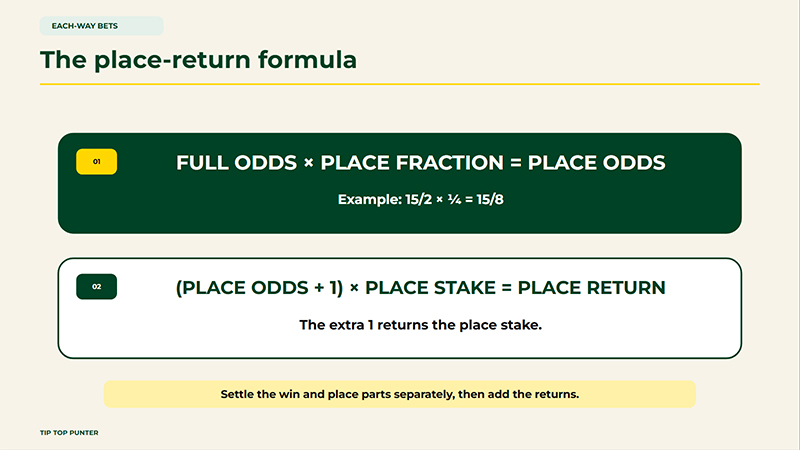
To work out the fractional place terms, use this formula:
Odds × 1/4 or 1/5 × the stake.
As an example, £10 placed at 15/2 at 1/4 odds would be:
15/2 x 1/4 x £10.
15/2 x 1/4 = 15/8.
15 + 8 ÷ 8 = 2.875 × £10 = £28.75 returned.
£10 placed at 15/2 at 1/5 odds would be:
15/2 x 1/5 x £10.
15/2 × 1/5 = 15/10.
15 + 10 ÷ 10 = 2.5 × £10 = £25 returned.
Incidentally, bookmakers usually write 15/10 as 6/4.
This may seem complicated or confusing. But with practice and experience, it does get easier.
Remember, with an each-way bet, if the horse wins the race, both parts of the bet pay out. The win bet pays the full odds multiplied by the unit stake. The place bet pays a fraction of the odds multiplied by the unit stake.
If the horse didn’t win the race but was placed, the win part of the bet loses. The place bet returns a fraction of the odds multiplied by the unit stake.
Question 4
Are you ready to attempt a more challenging fourth question?
You’ve placed £5 each-way on a horse at 10/1, which is a total stake of £10. The place terms are a fifth of the odds for the first three places. The horse won the race. What is the total return?
Again, you will find the answer at the end of this article - good luck!
Summarise
I hope my experience working as a bet settler for the bookies before technology took over helps you understand how to settle a bet. I hope it gives you an insight into what your bet is worth before you collect your winnings from the bookmaker.
But there is that dreaded Rule-4 - when a horse becomes a non-runner. That will affect your returns. Click here to learn more about Rule-4.
Struggling to find value winners? Click here and learn how to compile your own ratings!.
Question answers
Question 1
Answer: £52.50
Profit: £37.50 plus the £15 stake returned.
Question 2
Answer: £75
Profit: £65 plus the £10 stake returned.
Question 3
Answer: £10
Half the stake is £2.50 at 3/1.
Question 4
Answer: £70
The win bet: £55
The place bet: £15
A profit of £60, plus your £10 stake money returned.